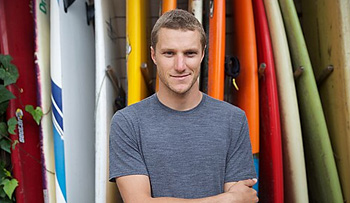
How Kyle Thiermann Turned a Viral Podcast Moment into a Breakout Debut Book and a Launch Built on Generosity
The Hook
Kyle Thiermann spent his twenties as a professional surfer and documentary filmmaker, traveling with Patagonia to tell stories about environmental injustices in coastal communities. Along the way, he became a podcaster — now past 400 episodes — and a copywriter and creative director at the wellness brand Mudwater. He had never written anything longer than 3,000 words.
His debut book, One Last Question Before You Go, is the result of following an idea that refused to go away — and of going through the uncomfortable emotional process the book itself asks readers to undertake.
The Problem: An Idea That Wouldn't Leave
The book's origin traces to early 2020, when COVID was first making headlines and, as Kyle puts it, "all of us thought, holy shit, are our parents going to die right now?" He had been podcasting for years but had never interviewed his own father — a 75-year-old documentary filmmaker in Santa Cruz, California, who had spent his career traveling the world making films. Kyle finally had him on, and the response was unlike anything he'd seen.
The episode generated far more shares and listener emails than he expected. People wrote in saying they wanted to interview their parents too. During COVID, he turned that signal into an article for Patagonia's blog called "How to Interview Your Dad and Why You Should Do It Now", which generated another wave of response. He filed the idea away and spent the next few years as a full-time copywriter and creative director.
But the idea kept nagging at him.
"I think that a lot of times the ideas that you know you should invest in are the ones that won't go away."
When he left his full-time role and had mornings free again, he started writing — late 2022 into 2023. What began as a practical how-to guide evolved into something more personal and more difficult. Early in the writing process, a hospice nurse friend told him at dinner that patients who had worked through their relationships with their parents had a far easier time in their final days. That realization shifted the scope of the book.
"The promise of the book and what interviewing your parents can do is be a kind of empathy drug because somewhere along that way, you see your parent as a person and you see them as a child and you see what culture was like when they grew up."
The book became what he describes as "a memoir with how-to interwoven" — the spine of it being his personal story of having a mother he loves deeply, losing her to conspiracy theories, and using the interview process to repair and mature that relationship. Writing it required putting things on the page that were uncomfortable, potentially hurtful, and deeply personal.
"My two biggest fears while writing this book was A, I was going to Really mess up my relationship with my family and and the second fear was that the book would come across as saccharine."
Why Scribe
Scribe had been recommended to Kyle early in the process. He first attempted the traditional publishing route, signing with an agent at DeFiori and pitching to the Big Five over two to three months. The feedback was consistent: strong writing, clean manuscript, but the hybrid memoir-and-how-to format was hard to categorize. His agent, who would not financially benefit from Kyle walking away, gave him this: he didn't want to see Kyle Frankenstein the book into a pure how-to after having put his heart on the page.
Kyle agreed. He came back to Scribe.
"Scribe very gracefully took me back, you know."
He had heard from a fellow author that the Scribe process was every bit as rigorous as a traditional publisher. Kyle's own experience confirmed it.
"Adam said, and I agree that it is every bit as professional as having gone through a Penguin Random House."
"The editing that I received from the global feedback all the way down to the sentence-by-sentence feedback to just feeling like, okay, I know where we are to really meeting deadlines and doing a huge amount. It's a part-time job the whole time working with Scribe."
He also highlights that Scribe pushed him toward the kind of honesty that made the book what it is.
"I think that you also really encourage people to be as honest as possible. And I felt that with the feedback that I got in the book. It was very thoughtful human feedback."
The Results
The book launched on November 18. Kyle coordinated approximately a dozen simultaneous podcast interviews and newspaper articles for launch week, held live events at Mudwater's LA space and four Patagonia stores, and mailed approximately 150 personalized signed books to influencers and podcast hosts as part of a generosity-first marketing strategy.
"[I]f I can sum my marketing strategy up into one phrase, it's givers are getters."
At the Santa Cruz launch event alone, approximately 200 people attended.
"People cried in the audience. People laughed. That's what I wanted to have happen."
The emotional results of the writing process itself proved as significant as the launch numbers. Kyle describes his relationship with his mother — the subject at the center of the book — as genuinely transformed, not in a Disney-ending way, but in a quieter, more mature way.
"The biggest change with my relationship with my mom is that I just feel way more mature about it. I can just be nicer to her."
Readers have reported using the book as more than a how-to guide. Many are bringing it to dinner tables and using the chapter-heading questions — written as interview questions on the advice of author Neil Strauss — as conversation starters with their parents. Others are using the book as a kind of permission slip for difficult conversations they'd wanted to have but hadn't known how to start. And a number of parents, rather than children, have been buying the book to interview their own kids.
One friend's Amazon review captured it simply: "a book for everyone whose parents are mortal." [Q29 — note: this is a reader's review as recounted by Kyle, not Kyle's own words]
The book continues to find readers across different angles than Kyle originally expected. A copy mailed to Leanne Kreischer led to an appearance on her podcast Wife of the Party and an invitation to Bert Kreischer's holiday party — one of approximately 150 outreach copies that Kyle describes this way:
"Those 150 books that I sent out, they are prayer lanterns that you send out to the sea, but all it takes is one, right? All it takes is one, and then you're like, holy shit, wow, that was potentially life-changing."
What Kyle Says About the Process
Kyle closes with an observation about what the writing process itself gave him — independent of any sales outcome.
"The benefit of doing that and having you guys encourage me to do that is that the outcome almost doesn't matter anymore because you just deepen so much on a soul level, which is what I think books can do for writers and it's what I think they can do for readers."
"I feel so fucking proud of it. I'm psyched on the result of it."
NOT FOUND
- Section: Specific revenue or business ROI from the book — Kyle discussed the book's emotional and personal results extensively, and described a coordinated launch, but did not cite revenue figures, new client counts, or specific business outcomes. These sections were not written.
- Section: Specific Scribe team member names — Kyle praised the process and editing quality but did not name specific editors, ghostwriters, or team members by name.
Ready to Write Your Success Story?
Join 1,600+ authors who have published with Scribe Media and transformed their careers.
Schedule a Consult